Is this number trustworthy?
Decide whether a KPI can go into an external document.
The question isn't whether the number is right. It's whether you can defend it in a meeting.
KPI Background holds the definition: KPI name, Category, Unit, Measurement, Direction of valuation, Included in Planning and Status.
Measurement decides how the monthly values roll up over a longer period. Cumulative (Σ) adds them, so year-to-date is a sum of the months. Average (Ø) takes the mean. Last value takes the closing figure, and First value the opening one — the right choice for a balance or a headcount, where adding twelve months together would be meaningless.
It also decides what the detail page header says: an averaged KPI shows Year to date Ø, a cumulative one shows Year to date without it.
Two more fields decide whether you can use the figure. Direction of valuation records whether higher or lower is the good outcome for this KPI, and every colour on every screen follows from it. Status says whether the definition has been validated; a KPI reading Unvalidated has never been signed off by anyone.
Read them together with the header: a number whose Last update is months old, whose Responsible is Not Assigned, and whose Status is Unvalidated has nobody standing behind it. That is a different thing from being wrong, and a better reason to check before quoting it.
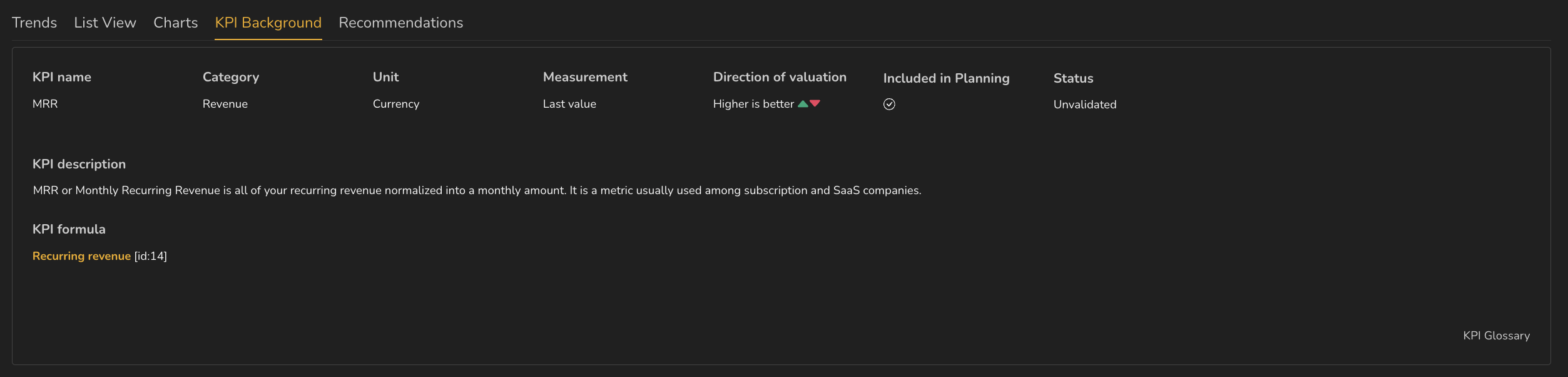
- 1Unit and Measurement
- 2Direction of valuation — Higher is better
- 3Included in Planning
- 4Status — Unvalidated
- 5KPI description, written for humans
- 6KPI formula, linking to the KPI it is built from
ValueWorks 2026.08
Takeaways
Direction of valuation records which way is good for this KPI, and every colour follows from it.
Measurement — cumulative, average, last value or first value — decides how months roll into a period.
Status tells you whether the definition was ever signed off.
No owner, no recent update and no validation is not the same as wrong — but it is a reason to check.
Surfaces covered
- Reporting
Also taught in the Academy
Module 3 · Investigate a number
Take it as lesson 3.2 in Business Analyst & FP&A