Lesson 4 of 10 · 3 min
Reading the calculation
Trace a KPI back through the things it is built from.
Three kinds of building block, four operators, and brackets. That is the whole language.
A query canvas holds components joined by operators.
There are three components. A Subquery pulls in another KPI, so following it takes you a level deeper. A Source Table reads directly from imported data. A Constant is a fixed number.
The operators are +, −, ×, ÷ and [ ] brackets. Brackets are worth attention: they decide the order things happen in, and a misplaced pair produces a number that is wrong without looking wrong.
Following subqueries down is how you answer "what would change this KPI". If a query is a chain of subqueries, the thing to fix is rarely the KPI you started on.
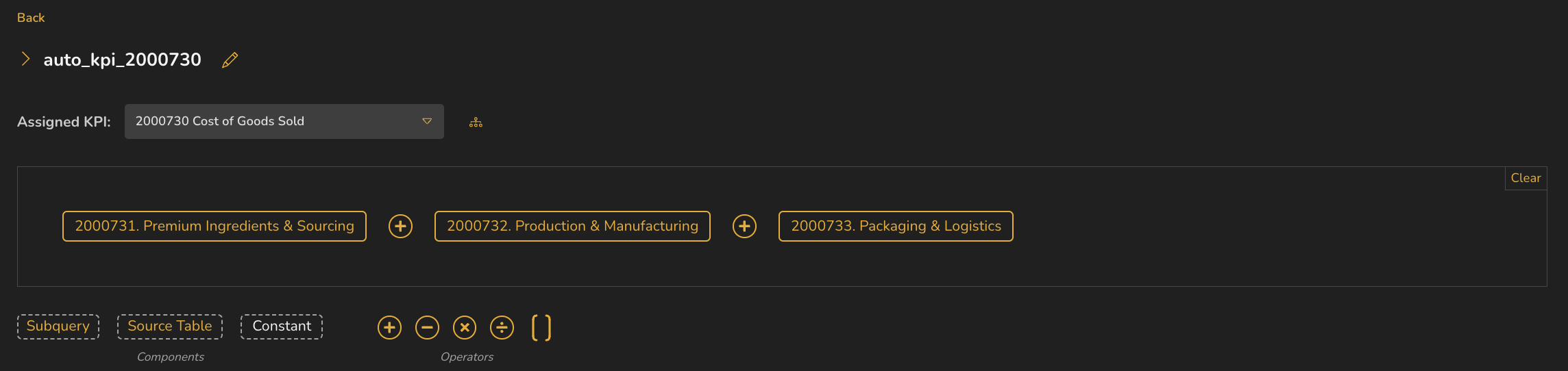
- 1Assigned KPI — the KPI this query populates
- 2Component chips, each carrying the id of the KPI it pulls
- 3The operators joining them
- 4Components — Subquery, Source Table, Constant
- 5Operators, including brackets
ValueWorks 2026.08
Takeaways
Three components: Subquery pulls another KPI, Source Table reads imported data, Constant is fixed.
Operators are + − × ÷ and brackets, and brackets decide the order.
Following subqueries down is how you find what actually moves a KPI.
Surfaces covered
- Query Builder
Micro-check
Two quick questions
Practice only — nothing here is scored or recorded.
1. A query is built from three subqueries. What does that tell you about fixing it?
2. Which component reads directly from imported data rather than another KPI?